


The percentage on the label is the first thing people look at when choosing a product, and it is usually read as “the higher the percentage, the stronger the product”. Yet the same number tells you something different depending on the type of product, its pH and what the label is actually measuring.
In short: The active percentage shows an ingredient's share of the formula: in a serum labelled 10% niacinamide, ten per cent of the formula is niacinamide. The effect does not depend on the percentage alone; with acids, the pH, whether the product is rinsed off and how often you use it also change the result. A higher percentage can also increase the likelihood of irritation. The percentage on the label sometimes refers to a group of ingredients (1.2% AHA) or to a raw-material solution (5% Caffeine Solution).
What does the active percentage mean?
The active percentage is the share of the formula taken up by the ingredient that does the product's main job: in a toner labelled 2% salicylic acid (BHA), two per cent of the formula is salicylic acid. Even so, the percentage is not a measure of strength on its own. The US Food and Drug Administration (FDA) states that in products containing AHAs, the degree of exfoliation depends on the type and concentration of the acid, the pH of the product and the other ingredients in the formula.
Nor does every percentage on a label carry the same kind of information. Examples from s'hevec labels:
| Wording on the label | What it shows | What it does not show |
|---|---|---|
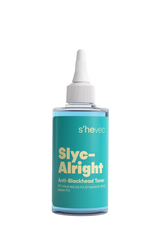
| 2% salicylic acid (Slyc-Alright) | The share of a single ingredient in the formula | The pH and how long it stays on the skin |
| 1.2% AHA (Slyc-Alright) | The combined share of a group of acids | The individual share of each acid in the group |
| 5% Caffeine Solution (Power De-Puff Girls) | The share of the caffeine solution added to the formula | The share of pure caffeine |
Is a higher percentage better?
Not always; a higher percentage can increase the effect, but it can also increase the likelihood of irritation.
- AHAs: a review concludes that whether these acids are beneficial or harmful to the skin depends on their concentration, and calls for care with reactions such as swelling, burning and itching in people who use AHA products.
- Strong exfoliants: according to the FDA, more serious adverse reactions are seen most often with the products that provide the highest degree of exfoliation.
- Niacinamide: a review notes that the ingredient's effects on the skin vary with concentration.
The right question is not “which has the highest percentage?” but “what does this percentage do in this type of product and on my skin?”
Does the same percentage have the same effect in every product?
No; with acids in particular, pH changes how the same percentage behaves on the skin. In a controlled study with lactic acid, the exfoliating effect depended largely on pH when the concentration was held constant, and varied with concentration when the pH was held constant; the authors suggest that it is the “free” part of the acid that is active.
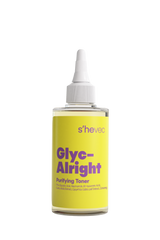
The industry safety assessment (CIR) cited by the FDA also sets its condition for glycolic and lactic acid products in terms of both concentration and pH: the AHA concentration should be 10% or less, and the pH of the final product 3.5 or higher. As the FDA reports it, this condition applies to products intended for consumers' own use; at s'hevec, the AHA percentage of Red Velvet Face is above this limit: its box states “For professional use only.” This is why s'hevec states the pH range alongside the percentage on its acid toners: pH 3.5–4.0 for Glyc-Alright Glycolic Acid Toner and 3.9–4.2 for Slyc-Alright Salicylic Acid Toner. We explain how to read a pH value in our article what is skin pH.
Why is the same ingredient used at different percentages in different products?
Because the right percentage depends on the type of product and how long it stays on the skin. The 2% niacinamide in Magic Foam Party is in a foaming cleanser and is rinsed off after brief contact; the 10% niacinamide in Hi Girls Bye Pores Pore Serum, by contrast, does the product's main job in a leave-on serum. In Glyc-Alright, 2% niacinamide is the second key active alongside 7% glycolic acid. We answer how to choose the percentage in a serum in our guide how to use a niacinamide serum. s'hevec serums are brought together in our face serums collection.
What does a group percentage mean?
A group percentage shows not a single ingredient but the total of several ingredients of the same kind. The 1.2% AHA in Slyc-Alright is a low-concentration AHA complex that works on the surface alongside 2% salicylic acid. In the ingredient list, more than one AHA, such as Glycolic Acid, Lactic Acid and Malic Acid, appears under its own name; the label does not give the share of each one separately.
So seeing the name of an acid in the list does not mean it is the key active: in Slyc-Alright, glycolic acid is not the key active but part of the low-concentration AHA complex.
Does “5% Caffeine Solution” mean five per cent caffeine?
No; this wording shows the share of the caffeine solution added to the formula, and the share of pure caffeine in the solution is lower. For how caffeine is used around the eyes in Power De-Puff Girls Eye Serum, see our caffeine eye serum guide, which explains it step by step.
Do the percentages of two products add up?
No; two products do not turn into a single formula on the skin. When you apply Hi Girls Bye Pores after Glyc-Alright, you have not applied a product containing as much niacinamide as the two percentages combined; each product works at its own concentration and pH.
What does add up is the acid load your skin meets on the same evening. Keep Glyc-Alright and Slyc-Alright to different evenings, and do not add a peel on an evening when you use an acid toner.
Why does s'hevec state at most one or two percentages per product?
Because a percentage is meaningful for the ingredient that does the product's main job. Slyc-Alright lists 2% salicylic acid and 1.2% AHA; zinc PCA, sodium PCA and 8D hyaluronic acid are supporting ingredients that complete the formula and are listed without percentages. A label carrying five separate percentages makes it harder to see which ingredient does the work. To learn what the order of the list shows, see our guide to reading an INCI list.
When should you move to a higher percentage, and who should take care?
- Newcomers to acid care and sensitive skin: start with a low-concentration product used infrequently, and try a new product on a small area first; move to a higher percentage when your skin comfortably tolerates your current product.
- Anyone using acid products: AHAs can increase the skin's sensitivity to the sun: apply sunscreen every morning while using this product and for one week after you stop. When you use products containing BHA, also apply sunscreen every morning.
- Ongoing irritation: if you experience long-lasting stinging, burning or redness, stop using the product; if it does not go away, see your doctor.
If you are pregnant or breastfeeding, or have a skin condition, consult your doctor before use. This step is not skipped when moving to a high-concentration acid product either.
Frequently asked questions
Is a product that does not state its percentage unreliable?
Not stating a percentage is not, on its own, an indicator of quality. A product that does state its percentage, however, shows the share of its key active and makes comparison easier.
Is a low-percentage product ineffective?
A low percentage often reflects a different job or a starting level. For someone new to acid care, a low-concentration product is often the right first step.
Can I work out the percentage from the ingredient list?
No. The order in the list gives a rough idea but does not tell you the percentage; you can only know it if it is stated on the label or in the product information.
Why don't sunscreens state ingredient percentages?
In sunscreens, the level of protection is shown by the SPF value. s'hevec sunscreens do not state ingredient percentages; the label carries an SPF 50+ statement.
Sources
- U.S. Food and Drug Administration (FDA). Alpha Hydroxy Acids.
- Tang SC et al. Dual Effects of Alpha-Hydroxy Acids on the Skin. Molecules. 2018.
- Thueson DO et al. The roles of pH and concentration in lactic acid-induced stimulation of epidermal turnover. Dermatol Surg. 1998.
- Wohlrab J et al. Niacinamide - mechanisms of action and its topical use in dermatology. Skin Pharmacol Physiol. 2014.
This content is for information only and does not replace medical advice. s'hevec products are cosmetic products and are not intended for medical treatment. It was prepared by the s'hevec Team on the basis of the s'hevec product data library and the sources listed above.


