


On the label of an acid toner, you will see a pH range next to the concentration. To read this number correctly, you first need to know the skin's own pH, and then how cleansing and acid products change it.
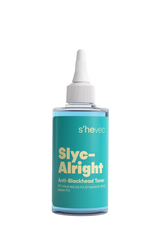
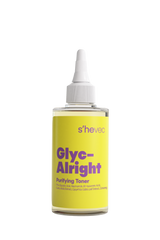
In short: The skin's surface is acidic, and some functions, such as barrier renewal, are linked to this acidity. Washing – even rinsing with water alone – raises skin pH. In acid products, pH determines the effect as much as the concentration does. pH ranges at s'hevec: Glyc-Alright 3.5–4.0, Slyc-Alright 3.9–4.2, Red Of Love 3.6–3.9 (rinse-off), and Rice Rice Baby, which contains no AHA or BHA for exfoliation, 5.5–6.5.
What is skin pH?
Skin pH is the value that shows how acidic the skin's surface is. The pH scale runs from 0 to 14; 7 is neutral, below that is acidic and above it is alkaline. The scale is logarithmic: a difference of one unit is a tenfold difference in hydrogen ion concentration, so the gap between pH 3.5 and 5.5 is bigger than it looks. According to a review on measurement, skin pH is not constant; it is influenced by the body's physiology, the products applied and environmental conditions.
Why does it matter that the skin is acidic?
An acidic surface is one of the conditions the barrier needs in order to work. A review on skin pH and cleansing notes that some barrier functions, such as barrier renewal and the antimicrobial response, are linked to the acidity of the skin's surface; when pH rises, barrier function and the skin flora are adversely affected.
Should you wash your face with soap?
For the face, a gentle, low-pH cleanser is a better choice than soap. According to the same review, cosmetic products – especially soaps and cleansing products – can cause marked changes in skin surface pH. Traditional soap is alkaline by nature, whereas cleansers made with synthetic surfactants can be formulated at a lower pH. The review notes that cleansing and care products with a pH of 4.0–5.0 may help preserve the acidic surface, and that the surfactant blend matters as much as product pH in reducing the risk of irritation.
In practice, it also helps not to wash your face more often than necessary: pH rises even after a single wash, and it can take up to a few hours to return to its physiological level.
Why does pH matter in acid products?
Because pH, together with concentration, determines how an acid acts on the skin. In a controlled study with lactic acid, when the acid concentration was kept constant the exfoliating effect depended largely on pH, and when pH was kept constant the effect varied with concentration; the authors suggest that it is the “free” portion of the acid that is active. As pH falls, the free (non-ionised) portion of the acid increases.
The rule of thumb: the same acid, even at the same concentration, behaves differently at a different pH; read the concentration and pH on the label together. A lower pH is not always better; stronger exfoliation can also make tingling and redness more likely on sensitive skin. What the percentage on the label tells you on its own, and what it does not, is explained in detail in the article on what active concentration means.
What pH should a toner have?
There is no single right value; a toner's pH is set according to its purpose. In a toner with exfoliating acids, a low pH is a deliberate choice so that the acid can work; in a toner not intended to exfoliate, pH can be kept closer to the skin's own range. This is how the distinction looks across s'hevec products:
| Product | Key actives | pH | Use |
|---|---|---|---|
| Glyc-Alright | 7% glycolic acid + 2% niacinamide | 3.5–4.0 | Evening, leave-on |
| Slyc-Alright | 2% salicylic acid + 1.2% AHA | 3.9–4.2 | Evening, leave-on |
| Red Of Love | Rinse-off peel containing AHA and BHA | 3.6–3.9 | Evening, rinsed off after 5–10 min; no more than 2 times a week |
| Rice Rice Baby | 5% rice extract + 3% niacinamide | 5.5–6.5 | Morning and evening, leave-on |
Glyc-Alright Glycolic Acid Toner and Slyc-Alright Salicylic Acid (BHA) Toner are in a similar pH range but contain different acids: the first targets surface texture, the second the look of blackheads and pores. Red Of Love AHA/BHA Peel Serum is in the same pH band but does not stay on the skin; it is rinsed off thoroughly with water and is not applied to the eye area. Rice Rice Baby Brightening Rice Toner contains tranexamic acid, but this ingredient does not work as an exfoliant, which is why its pH is higher. The three acid products are used in the evening and call for sunscreen the next morning. For the place of exfoliating and non-exfoliating toners in a routine, see what a toner does. Toners can be found in our face toners collection.
Does an acid toner upset the skin's pH?
An acid product shifts skin pH towards the acidic side, not upwards. In the cleansing review, the negative effect on the barrier and flora is linked to the rise in pH after washing; with an acid product, the shift goes the other way. In a study testing two creams with different glycolic acid concentrations, the products made the skin's surface more acidic in both short- and long-term use, and the effect was stronger in the higher-concentration sample. The authors report that they observed no barrier disruption or signs of irritation, and that acidification depended on the proton-donating ingredients in the formula and their concentrations. This result applies to those two creams; it cannot be generalised to every product or every skin. The structure of glycolic acid and its effect on the skin are covered separately in our glycolic acid guide.
Who should take care with acid products?
- Sensitive skin: start a low-pH product at a low frequency, after a patch test on the inner forearm. For very sensitive skin, you can start with a toner with a higher pH that is not intended to exfoliate, instead of an acid product.
- Sun exposure: AHAs can increase the skin's sensitivity to the sun: apply sunscreen every morning while using this product and for one week after you stop. While using products containing BHA, also apply sunscreen every morning.
- Irritated skin: do not apply acid products to broken or irritated skin, or to skin that has recently undergone a procedure; stop using them if you experience intense burning or redness.
- Special circumstances: If you are pregnant or breastfeeding, or have a skin condition, consult your doctor before use. This includes low-pH acid products.
Frequently asked questions
What should the skin's pH be?
The skin's surface is acidic, but it would not be accurate to give a single value that applies to everyone; the measured value varies with physiology, the products applied and ambient conditions. In daily care, what matters is how far your cleansing and product choices push this acidity upwards.
Can you measure skin pH at home?
Not reliably. Studies use devices such as a flat glass electrode that touches the skin, and many factors that affect the result have to be kept under control; simple home tests do not meet these conditions.
Does washing your face with water alone also change pH?
Yes. According to the cleansing review, rinsing the skin with water alone also raises surface pH; the value returns to its own level after a while. This is a reason to avoid washing unnecessarily often, not a reason to give up water.
Is every ingredient with “acid” in its name an exfoliant?
No. Tranexamic acid and hyaluronic acid carry “acid” in their names but do not exfoliate. Whether a product exfoliates is shown not by an ingredient's name but by whether it contains AHA or BHA, and by its pH.
Can you use two low-pH products on the same evening?
It is not recommended. Do not layer any two of Glyc-Alright, Slyc-Alright and Red Of Love on the same evening; if you use more than one acid product, spread them across different evenings.
Sources
- Blaak J et al. The Relation of pH and Skin Cleansing. Curr Probl Dermatol. 2018.
- du Plessis JL et al. Measurement of Skin Surface pH. Curr Probl Dermatol. 2018.
- Lukic M et al. Formulation of topical acidic products and acidification of the skin - Contribution of glycolic acid. Int J Cosmet Sci. 2021.
- Thueson DO et al. The roles of pH and concentration in lactic acid-induced stimulation of epidermal turnover. Dermatol Surg. 1998.
This content is for information only and does not replace medical advice. s'hevec products are cosmetic products and are not intended for medical treatment. It was prepared by the s'hevec Team on the basis of the s'hevec product data library and the sources listed above.


