


Trying a new skincare product on a small area before applying it to your whole face is the simplest way to spot a possible reaction early. The test does not give you certainty; reading the result correctly is part of the process.
In short: For a patch test, apply the product to the inner forearm or the inside of the elbow, on a coin-sized area, in the amount you would normally use. The AAD recommends applying it twice a day for 7–10 days; rinse-off products such as cleansers are left on for 5 minutes, or for the time stated in the directions, and then rinsed off. If at the end of this period the test area has not become red, itchy or raised, you can move the product to your face. With acid products, do not test more often than the product's recommended frequency.
Why do a patch test?
Even a product chosen to suit your skin type can irritate your skin; a patch test is done with this possibility in mind. The American Academy of Dermatology (AAD) notes that an ingredient such as a preservative can trigger an allergic reaction that makes the skin red, itchy and swollen. Trying the product on a small area first helps you anticipate such a reaction before you experience it on your face.
How do you do a patch test? Step by step
The product is tried on a small area that will not be rubbed, in the amount and for the time you would use it day to day, and any reaction is monitored. The AAD's steps:
- Choose the area. Choose an area where the product will not be rubbed or washed off: the inner forearm or the inside of the elbow.
- Apply the normal amount. On a coin-sized area, apply the product in the amount and thickness you would use regularly.
- Leave it on for the normal time. Leave the product on for as long as it would normally stay on your skin. Leave a rinse-off product such as a cleanser on for 5 minutes, or for the time stated in its directions, then rinse it off.
- Repeat. Repeat the application twice a day for 7–10 days.
- Assess. Check the test area before each application. If there is no redness, itching or raised skin in the area after 7–10 days, you can start using the product.
How do you adapt the test to the type of product?
The AAD protocol recommends the same frequency for all products; the only difference with rinse-off products is that the product stays on the skin for 5 minutes or for the time stated in the directions. With acid products or products used less often, however, the test should not go beyond the frequency the product recommends; this adaptation is our recommendation, not the AAD's. The US Food and Drug Administration (FDA) also recommends trying a product containing BHA on a small area before applying it to a large one, and not exceeding the number of applications recommended on the label.
| Type of product | s'hevec example | How to test |
|---|---|---|
| Leave-on toner | Rice Rice Baby Brightening Rice Toner (pH 5.5–6.5; morning and evening) | Follow the AAD protocol as it is |
| Rinse-off cleanser | Magic Foam Party Foaming Face Cleanser | Work into a lather, leave on the inner forearm for 5 minutes, then rinse off |
| Rinse-off peel | Red Of Love AHA + BHA Peel Serum (pH 3.6–3.9) | Leave on without exceeding the 5–10 minutes in the directions and rinse thoroughly with water; no more than 2 test evenings a week |
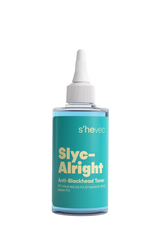
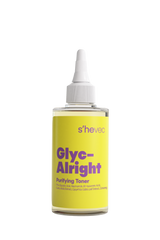
| Acid toner (leave-on) | Glyc-Alright, Slyc-Alright | Only on evenings at the starting frequency (2–3 a week); not applied twice a day |
| Eye serum | Power De-Puff Girls | 1–2 drops, morning and evening; a forearm test may not fully reflect how sensitive the eye area is |
| Peel-off mask | Rice Vibes Only | A thick layer on a hair-free area; leave until it dries into a film (15–20 minutes), peel off and rinse; do not exceed 1–2 times a week |
| Sunscreen | Just Protected From Sun SPF 50+ | Like a leave-on product, following the AAD protocol; in a normal thickness |
Red Velvet Face is not included in this table; its box carries the line “For professional use only.” Do not use Red Of Love and Red Velvet Face together. We explain who it is not suitable for in our article who can use high-concentration AHA/BHA peels. How often to use acid products after the test is the subject of our article how often to do a chemical peel.
How do you interpret the result?
There are three ways to read the result; what matters is whether there is a visible reaction beyond a passing sensation:
- No reaction at all: you can add the product to your routine.
- Mild, brief tingling: the AAD notes that some ingredients, such as retinol and glycolic acid, can cause irritation, especially on sensitive skin, and that this can be normal and temporary. The pages of our acid products also state that mild tingling may occur during the first few applications. If the tingling does not pass within a few minutes, turns into burning or leaves redness on the test area, it no longer counts as a passing sensation; stop using the product at that point.
- A visible reaction on the test area: if the area has become red, itchy or raised, end the test that day; gently wash the product off as soon as possible and do not use it again. The AAD notes that, if needed, the skin can be soothed with a cool compress or petroleum jelly.
If there was no reaction, is the product definitely suitable? No. The AAD describes the test as a way of helping to anticipate an adverse reaction, not as an assurance. According to a review by Fluhr and colleagues, the structure and function of the skin's outermost layer vary with the body area, age and skin type; so a product that causes no problems on the inner forearm may feel different on the face. As defined by Misery and colleagues, sensitive skin is characterised by sensations a person notices on their face, such as tightness, stinging, burning, tingling and itching, and it can also occur in people with normal skin. So keep watching your face during the first few weeks after the test. The test only shows how your skin reacts to that product. If you are pregnant or breastfeeding, or have a skin condition, consult your doctor before use.
Is a test at home the same as a patch test done by a doctor?
No. A test at home shows whether a product causes problems on your skin; the patch test a doctor carries out, on the other hand, aims to find out which ingredient caused a reaction. The AAD recommends seeing a dermatologist if the responsible ingredient is hard to identify; once the cause has been found, you need to avoid that ingredient. For example, if you react to fragrance, choose products labelled “fragrance free”; products labelled “unscented” or containing plant ingredients may still contain fragrance-related ingredients.
Do you need to test again when a formula changes?
Yes; a product whose ingredient list has changed counts as a new product for your skin. For example, the Hi Girls Bye Pores formula was updated in March 2026; the current formula focuses on the look of pores. Even if you used the old formula without problems, repeat the forearm test when switching to the new formula, and check the new INCI list against the one on the product page.
How do you start using a product after the test?
A product that passes the test is added to your routine on its own. In our article on sensitive skin care, we explain step by step in which order and how often to introduce actives on sensitive skin. Products whose labels include sensitive skin among the recommended skin types are brought together in our collection of care products for sensitive skin.
When should you see a doctor?
If a reaction does not go away or its cause cannot be found, see a dermatologist, particularly in these situations:
- If the reaction is severe and does not settle with a cool compress or petroleum jelly (AAD).
- If a salicylic acid (BHA) product leaves long-lasting stinging on the test area or irritates it, stop using the product and consult your doctor; the FDA also recommends this for BHA.
- If you cannot work out which ingredient caused the reaction.
Frequently asked questions
How long does a patch test take?
The period the AAD recommends is 7–10 days. With acid toners used on 2–3 evenings a week, apply only on those evenings during this period; do not test more often to speed up the result.
Do you do a patch test on the face?
No, the test is done on the inner forearm or the inside of the elbow; the AAD recommends these areas because the product will not be rubbed off there. The product goes on your face only after the forearm test has passed without problems.
Can you test more than one product at the same time?
It is not recommended; if there is a reaction, you cannot tell which product caused it. Test products one after another and add them to your routine one at a time too.
The test went fine, but my face stings. What should I do?
Use the product less often and check that you are not using another acid product, a peel or retinol on the same evening. If the stinging comes with a visible reaction, wash the product off and stop using it.
Sources
- American Academy of Dermatology (AAD). How to test skin care products.
- U.S. Food and Drug Administration (FDA). Beta Hydroxy Acids.
- Fluhr JW et al. Epidermal barrier function in dry, flaky and sensitive skin: A narrative review. J Eur Acad Dermatol Venereol. 2024.
- Misery L et al. Sensitive skin. J Eur Acad Dermatol Venereol. 2016.
This content is for information only and does not replace medical advice. s'hevec products are cosmetic products and are not intended for medical treatment. It was prepared by the s'hevec Team on the basis of the s'hevec product data library and the sources listed above.


