


When several new products are added to sensitive skin at the same time, it becomes hard to tell which one is causing stinging or burning. That is why moving on to active ingredients relies on first building a base with few steps and then adding products one at a time.
In short: For sensitive skin, the routine is built on three basic steps: gentle cleansing, hydration and sunscreen in the morning. Once this base feels comfortable, move on to actives one product at a time and at the lowest frequency: once a day for a 10% niacinamide serum, a few evenings a week for a glycolic acid toner. Each new product is tried on a small area first; if the skin reacts during the trial, that product is not added to the base.
What is sensitive skin?
Sensitive skin is skin that reacts with sensations such as stinging, burning, tingling, itching and tightness to products and conditions that should not normally cause discomfort; the definition is based on these sensations as reported by the person. According to a review, these people report exaggerated reactions on contact with cosmetic products, soaps and sunscreens, yet often there is no visible sign of irritation. Sensitivity can occur both in normal skin and in skin with a weakened barrier. So in practice, it helps to think of it not as a separate skin type but as a state that can accompany any skin type: your skin type decides the texture of a product, and your sensitivity decides how often you use it.
The cause is not fully understood: the symptoms point to the involvement of nerve fibres in the skin and temperature-sensitive channels, and in some people the uppermost layer of the skin is thinner. We explain its link with the barrier in our article what is the skin barrier.
What should a basic routine for sensitive skin look like?
The basic routine consists of gentle cleansing, moisturising and sunscreen in the morning; optionally, a toner without exfoliating acids and a hydrating serum are added. Products that fit this base are among our skincare products for sensitive skin.
| Step | When | Example at s'hevec and formula note |
|---|---|---|
| 1. Cleanse | Morning and evening | Magic Foam Party Foaming Face Cleanser: 2% niacinamide, CICA (centella asiatica extract) and PHA; contains no SLS or parabens |
| 2. Toner (optional) | Morning and evening | Rice Rice Baby Brightening Rice Toner: pH 5.5–6.5; no AHA or BHA for exfoliation |
| 3. Hydrating serum | Morning and evening | Hydra Back Baby Hydrating Serum: 2% 8D hyaluronic acid, 1.2% Pentavitin |
| 4. Moisturiser | Morning and evening | Any Time Of Day: water-based, contains no silicones |
| 5. Sunscreen | Morning | The last step of the routine |
Two products in this base do not need a gradual start: the main ingredients of Hydra Back Baby are humectants, and Rice Rice Baby does not come with the “start with a few evenings a week” rule that applies to acid toners. The PHA in Magic Foam Party, meanwhile, stays on the skin only briefly in a rinse-off formula; the foam does not replace an exfoliant. Why the toner is applied with the palms on sensitive skin is explained in how to use a rice toner.
How do you introduce active ingredients to sensitive skin?
Once the basic routine feels comfortable, choose a single active, try it on a small area first and start at the lowest frequency recommended for the product. You can see your morning and evening routine step by step in the routine builder by selecting your skin type and your experience with active ingredients.
- Choose one active. As the American Academy of Dermatology (AAD) points out, it is not always easy to work out which ingredient is causing irritation. Adding products one at a time makes it easier to find the source of a reaction.
- Try it on a small area first. Before applying a new product to your face, try it on a small area for a few days; how to do this and how to read the result are explained in the steps of a patch test.
- Start at the lowest frequency and increase gradually. Move on to the next active only once your skin has got used to the previous one.
- Tell a normal sensation from a reaction. According to the AAD, ingredients such as glycolic acid and retinol can cause irritation, especially on sensitive skin; this is normal and temporary. Skin that turns red, itches or swells, however, is reacting to the product: gently wash the product off as soon as possible, do not use it again and, if needed, apply a cold compress.
Sensitive skin notes from our product pages:
| Active and product | Key active concentration | Starting on sensitive skin |
|---|---|---|
| Niacinamide serum: Hi Girls Bye Pores | 10% niacinamide | Once a day; a second application as the skin settles |
| Azelaic acid cream: Shine On You | 7% azelaic acid | Evening; every other day in the first weeks |
| Ceramide serum: Love In Blue This Time | 2% ceramide complex | Evening; limited to a few evenings a week in the first weeks |
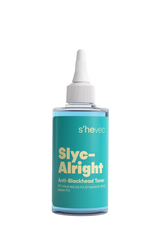
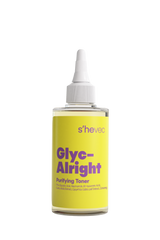
| Glycolic acid toner: Glyc-Alright | 7% glycolic acid, pH 3.5–4.0 | A few evenings a week. AHAs can increase the skin's sensitivity to the sun: apply sunscreen every morning while using this product and for one week after you stop. |
For very sensitive skin that is not ready for an acid toner, the acid step can be postponed; it is not a required part of the base.
What should you look for when choosing products for sensitive skin?
Look at the ingredient list rather than the “sensitive skin” wording on the label: fragrance, alcohol, acids and the same active repeated across several products are what matter.
In a study that examined products labelled for sensitive skin, the most frequently used active was niacinamide; soothing and barrier-supporting ingredients were also common. The same study notes that human studies on these ingredients were few and methodologically weak, and that niacinamide and panthenol were among the few ingredients tested on volunteers with sensitive skin. This should not be read as the result of any particular product on sensitive skin; what decides the choice is the ingredient list:
- Fragrance: if fragrance causes a reaction, the AAD recommends products labelled “fragrance free”; even products labelled “unscented” can contain fragrance components.
- Alcohol: appears in the INCI as “Alcohol Denat.” and is second in the list of Rice Vibes Only, whose product page recommends a low frequency for sensitive skin; Slyc-Alright contains no alcohol.
- Acids: as the pH difference in the tables above shows, Glyc-Alright and Rice Rice Baby are not the same step; the acid product is added to the base last.
- The same active repeated: niacinamide is found in Magic Foam Party, Rice Rice Baby (3%), Hi Girls Bye Pores and Any Time Of Day. The Hi Girls Bye Pores page says to reduce the frequency of the serum if redness occurs when it is used together with Any Time Of Day.
Are plant-based products more suitable for sensitive skin?
Not always: being plant-derived does not on its own show that a product suits sensitive skin. The AAD points out that plant-based products can also contain fragrance-related components. The same principle applies to our own formulas: Magic Foam Party contains chamomile and yarrow extract, and its product page says that people with a known sensitivity to these plants should not use it; Rice Vibes Only carries the same warning for bisabolol and chamomile.
How do you choose a sunscreen for sensitive skin?
By looking at the filter type and three criteria on the label. The AAD recommends physical (mineral) sunscreen for sensitive skin: its only active ingredients are titanium dioxide, zinc oxide or both. Whichever type you choose, it should be SPF 30 or higher, broad-spectrum (UVA and UVB) and water resistant.
- Filter type: can be read from the ingredient list on the label; the difference between mineral, chemical and hybrid is explained in what is a hybrid sunscreen.
- Trial: like other products, try a new sunscreen on a small area first; if burning or spreading redness occurs, stop using it.
- At s'hevec: the three criteria above are the AAD's general recommendation; the claims a sunscreen carries are shown on its label. The sunscreen whose label includes sensitive skin among the recommended skin types is the SPF 50+ Just Protected From Sun. As it is a hybrid formula, it does not meet the requirement of those looking for mineral filters only.
If sensitivity comes with the look of redness on the face, possible causes and care are covered in our guide to facial redness.
When should you see a doctor?
See a doctor when symptoms become constant or when a reaction to a product is severe; cosmetic care does not address the cause of sensitivity, but it helps support the skin's comfort.
- Sensitivity can also be among the symptoms of certain skin conditions. Redness on the face that lasts for weeks, or burning that does not go away even after you stop the product, may point to something other than a reaction to a skincare product; telling the two apart is only possible through a doctor's examination.
- The AAD recommends seeing a dermatologist if a reaction is severe and does not ease with a cold compress.
- If the source of a reaction cannot be found, a doctor may recommend formal patch testing; a trial at home does not replace it.
If you are pregnant or breastfeeding, or have a skin condition, consult your doctor before use. If you take medication regularly, also consult your doctor before starting a new active.
Frequently asked questions
Does sensitivity increase with the seasons?
It can. People with sensitive skin often report that their symptoms get worse in dry, cold weather. In the colder months, strengthening the hydration step and reducing the frequency of actives if needed helps support the skin's comfort.
Is a toner essential for sensitive skin?
No. If you want a toner, Rice Rice Baby can be used morning and evening; if you use an acid toner in the evenings, keep Rice Rice Baby for the morning so that the two toners do not overlap.
Can you use a peel on sensitive skin?
It is not a starting step. Red Of Love is a rinse-off peel with AHA and BHA: it is left on for 5–10 minutes and rinsed off with plenty of water, used no more than 2 times a week and not applied around the eyes. AHAs can increase the skin's sensitivity to the sun: apply sunscreen every morning while using this product and for one week after you stop. The product page recommends a low frequency and a small-area trial first for sensitive skin; for very sensitive skin, the first step is a toner without exfoliating acids. The box of Red Velvet Face, by contrast, carries the line “For professional use only.” It is for normal and oily skin accustomed to acid care, not for sensitive skin. Do not use Red Of Love and Red Velvet Face together. If sensitive skin needs an acid step, start with a low-frequency acid toner first.
What does tightness after washing your face mean?
It may show that cleansing is too harsh for your skin. Use less cleanser, use lukewarm rather than hot water and pat your face dry with a towel instead of rubbing.
Sources
- Misery L et al. Sensitive skin. J Eur Acad Dermatol Venereol. 2016.
- Berardesca E et al. Sensitive skin: an overview. Int J Cosmet Sci. 2013.
- Ferreira MS et al. Sensitive skin: Active ingredients on the spotlight. Int J Cosmet Sci. 2022.
- American Academy of Dermatology (AAD). How to test skin care products.
- American Academy of Dermatology (AAD). Understand sunscreen labels.
This content is for information only and does not replace medical advice. s'hevec products are cosmetic products and are not intended for medical treatment. It was prepared by the s'hevec Team on the basis of the s'hevec product data library and the sources listed above.


