


Tightness after cleansing, flaking, or sudden stinging from a product you have used for a long time often points to the protective structure in the outermost layer of the skin. Understanding this structure makes it easier to decide which products to pause and which to keep using.
In short: The skin barrier is the protective structure formed by the cells of the stratum corneum, the skin's outermost layer, and the layers of ceramides, cholesterol and free fatty acids that fill the spaces between them; it limits water loss and makes it harder for external substances to pass through. When it is weakened, you may notice tightness, flaking and stinging from products you are used to. To support it, in this order: gentle cleansing, a hydrating serum, moisturiser and, in the morning, sunscreen. Pause exfoliating acids until the stinging has passed.
What is the skin barrier?
The skin barrier is the set of structures, centred on the stratum corneum (the horny layer), that separates the skin from its surroundings. At the heart of this function is the lipid matrix within that layer. The matrix is made up of three main classes of lipids: ceramides, cholesterol and free fatty acids. These lipids form tightly packed, orderly layers stacked on top of one another (lipid lamellae). The role of ceramides in this lipid “mortar” is the subject of a separate article explaining what ceramides are and how they work in the skin.
The lipid matrix has two jobs: preventing excessive water loss from the skin, and stopping substances in the environment from reaching the living layers of the skin and triggering a defence response. A recent review describes the barrier as four interconnected layers:
- Physical: corneocytes and the lipids between them.
- Chemical: the slightly acidic environment of the skin's surface and the enzymes that work in it.
- Microbiological: beneficial microorganisms living on the surface.
- Immunological: the skin's defence response to external substances.
Disruption in one layer affects the others, which is why barrier care relies on the routine as a whole rather than on a single product. For a simple morning and evening routine based on your skin type, you can use the routine builder.
How can you tell if your skin barrier is weakened?
A weakened barrier usually shows up as a combination of tightness after cleansing, flaking and stinging from products you are used to; any one of these on its own is not a sufficient sign.
- Marked tightness after washing your face.
- Dryness, flaking or a rough-looking texture.
- Stinging, burning or tingling from products you previously used comfortably.
- More visible redness and skin that reacts easily.
Common triggers: long, hot showers, too much cleanser, rubbing your skin dry and squeezing several exfoliating acids into the same period. For the effect of cold weather and central heating on the barrier, see our winter skincare routine.
How can you strengthen your skin barrier?
The barrier is supported less by adding new actives and more by reducing the load on the skin and keeping it consistently hydrated. Many studies have shown that moisturisers reduce transepidermal water loss (the amount of water that evaporates through the skin); humectant, emollient and occlusive ingredients do this in different ways. Slightly acidic moisturisers are also reported to contribute to the chemical barrier by supporting enzyme activity and ceramide production.
Dry skin tips from the American Academy of Dermatology (AAD) that apply directly to barrier care:
- Limit showers to 5–10 minutes, use lukewarm water and pat yourself dry with a towel.
- Use just enough cleanser to lift away dirt, not enough to build a thick lather.
- Apply moisturiser while your skin is still slightly damp and whenever it feels dry; a cream texture holds in moisture more effectively than a lotion.
- While dryness persists, pause products that contain alcohol, fragrance or retinoids.
Can you use acids when your barrier is weakened?
While stinging, burning or flaking persists, pause exfoliating acids (glycolic acid, salicylic acid, AHA/BHA peels). The AAD notes that ingredients such as glycolic acid can cause irritation, especially on sensitive skin. A “slightly acidic moisturiser” that supports the barrier is not the same as low-pH toners and peels that clear away dead cells. Here is how this applies across the s'hevec range:
| Product | When the barrier is weakened | Why |
|---|---|---|
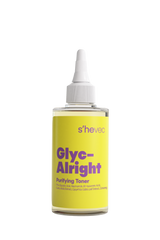
| Glyc-Alright | Pause | 7% glycolic acid, pH 3.5–4.0 |
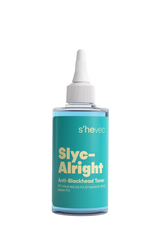
| Slyc-Alright | Pause | 2% salicylic acid and a low-concentration AHA complex, pH 3.9–4.2 |
| Red Of Love | Pause | Rinse-off peel containing AHA and BHA |
| Smooth Me All Night | Pause | Night serum containing AHA and a low concentration of BHA |
| Magic Foam Party | Continue | SLS-free and paraben-free; in this rinse-off formula, PHA stays on the skin only briefly |
| Hydra Back Baby | Continue | 2% 8D hyaluronic acid and 1.2% Pentavitin; a humectant that does not exfoliate |
| Any Time Of Day | Continue | Water-based and silicone-free; with a ceramide complex and panthenol as supporting ingredients |
| Love In Blue This Time | Support | 2% ceramide complex; also contains 2% Ethyl Ascorbic Acid (a vitamin C derivative) |
The “continue” rows have their limits too: the directions for Hydra Back Baby say not to apply it to broken or irritated skin, and those for Any Time Of Day say not to apply it to red or irritated areas; with Magic Foam Party, consult a doctor if irritation persists. If there is a red or irritated area, skip it and apply the product around it, or wait until the area has settled. Once your skin has calmed down, return to acids with a single product and use it infrequently; the upper limit in the directions for Red Of Love is no more than 2 evenings a week, so stay below this when you start again. AHAs can increase the skin's sensitivity to the sun: apply sunscreen every morning while using this product and for one week after you stop.
Example routine for barrier support
The aim is to reduce the number of steps and keep hydration steady; add only one product to your routine at a time. Hydration-focused serums and creams can also be found in our moisturisers collection.
| Step | Morning | Evening |
|---|---|---|
| 1. Cleanse | Lukewarm water or a gentle cleanser | Magic Foam Party, without rubbing |
| 2. Hydrating serum | Hydra Back Baby Hydrating Serum, on slightly damp skin | Hydra Back Baby |
| 3. Barrier serum | Not needed | Love In Blue This Time Ceramide and Copper Peptide Serum |
| 4. Moisturiser | Any Time Of Day Water-Based Moisturising Cream | Any Time Of Day |
| 5. Sunscreen | Last step | None |
In the ingredient list (INCI) of Love In Blue This Time, Niacinamide is second, Ethyl Ascorbic Acid third and Ceramide NP ninth; alongside the ceramide complex, the formula also contains a vitamin C derivative. Its directions say not to apply it to cracked, broken or irritated skin; skip this step while stinging persists and add it once your skin has calmed down.
What should you do if you notice signs of irritation?
If a newly added product makes your skin red or itchy or causes raised bumps on the surface while your barrier is weakened, the AAD recommends the following steps:
- Wash the product off your skin straight away with plenty of water, without rubbing; do not put the product that caused the reaction back into your routine.
- If needed, apply a cold compress or petroleum jelly.
- If you cannot tell which ingredient caused the reaction, consult a dermatologist; patch testing may be needed to find the cause.
- Before applying your next new product to your whole face, try it on a small area for a few days.
When should you see a doctor?
A cosmetic product supports the barrier; it does not replace a doctor's assessment of persistent dryness, itching or cracking. Barrier disruption is reported to play an important role in some skin conditions.
- If dryness persists despite the steps above: the AAD recommends seeing a dermatologist. When dryness and flaking do not go away even though you have simplified your cleansing and kept your skin consistently hydrated, only a doctor's examination, not skincare, can establish the cause; if itching or cracking comes with it, do not put off this assessment.
- If any product you apply, including moisturiser, causes burning, stinging or irritation.
- If the reaction is severe and does not settle with a cold compress.
- If you are considering an anti-itch cream: the AAD recommends asking a dermatologist first, as these products can irritate dry skin further.
Frequently asked questions
How long does the skin barrier take to recover?
It would not be accurate to give a timeframe; it depends on what caused the strain, your routine and the season. What to watch is whether tightness and stinging ease once you have stopped the habit that was straining your skin.
Are sensitive skin and a weakened barrier the same thing?
Not always. A weakened barrier is often linked to a habit or a particular period; sensitivity can have other causes too. We explain how to introduce active ingredients on sensitive skin in our article on sensitive skin care.
Can oily skin have a weakened barrier?
It can. Surface shine comes from sebum production and does not show how well the lipid matrix limits water loss; skin that looks shiny can still feel tight after cleansing. The triggers above, especially too much cleanser and exfoliating acids squeezed into the same period, can lead to tightness on oily skin too. Do not skip the hydration step; water-based and silicone-free, Any Time Of Day is designed for all skin types, including oily and combination skin.
How should you choose a sunscreen while your barrier is weakened?
The AAD lists sun protection as one of the steps of dry skin care: a broad-spectrum, water-resistant sunscreen with SPF 30 or higher, together with shade and protective clothing. This is the AAD's general recommendation; the claims a sunscreen carries are shown on its label.
Is a product labelled “unscented” the same as a fragrance-free one?
No. According to the AAD, products labelled “unscented” may contain substances that mask the smell of other ingredients, and these can irritate dry, sensitive skin; during this period, it is better to look for the wording “fragrance-free”.
Sources
- Rajkumar J et al. The Skin Barrier and Moisturization: Function, Disruption, and Mechanisms of Repair. Skin Pharmacol Physiol. 2023.
- van Smeden J et al. Stratum Corneum Lipids: Their Role for the Skin Barrier Function in Healthy Subjects and Atopic Dermatitis Patients. Curr Probl Dermatol. 2016.
- American Academy of Dermatology (AAD). Dermatologists’ top tips for relieving dry skin.
- American Academy of Dermatology (AAD). How to test skin care products.
This content is for information only and does not replace medical advice. s'hevec products are cosmetic products and are not intended for medical treatment. It was prepared by the s'hevec Team on the basis of the s'hevec product data library and the sources listed above.


