


How strong your cleanser should be, the texture of your moisturiser and how often you use an acid product all depend on your skin's oil and moisture tendencies. You do not need a device to understand these tendencies; a few days of careful observation give a rough but useful starting point.
In short: You can get a rough idea of your skin type by washing your face with a gentle cleanser, waiting without applying any product and watching how your skin behaves. Shine everywhere and oil marks on a tissue suggest oily skin; tightness, dullness and flaking suggest dry skin; shine only on the forehead, nose and chin suggests combination skin; and if nothing stands out, the tendency is normal. Stinging and burning point to sensitivity, which can occur with any type. Repeat the observation over a few days.
How can you tell your skin type at home?
By leaving your skin bare after cleansing, comparing the T-zone with your cheeks and repeating this over a few days.
- Cleanse. Wash your face with a gentle cleanser and pat it dry with a towel.
- Wait without applying anything. Do not apply toner, serum or moisturiser; let your skin settle back to its usual state.
- Note how it feels. Is there tightness, stinging or itching, or does your skin feel comfortable?
- Compare the areas. Press a clean tissue separately on your forehead, nose, chin and cheeks. Do oil marks come from everywhere or only from the T-zone? Are there any flaky or rough areas?
- Repeat. Do this again on different days and at different times; a single observation can be misleading.
| Observation | Likely tendency |
|---|---|
| Shine across the whole face, oil marks on every part of the tissue | Oily |
| Tightness, a dull and rough look, flaking in places, no oil marks | Dry |
| Shine on the forehead, nose and chin; cheeks comfortable or tight | Combination |
| No noticeable shine, tightness or reaction | Normal |
| Stinging, burning, itching or redness with products | Sensitivity (can occur with any type) |
How do you tell the five tendencies apart?
Four tendencies are distinguished by the balance of oil and moisture; sensitivity can accompany any of them.
- Oily: When the sebaceous glands produce too much sebum, skin looks shiny and greasy; oiliness can vary with diet, age, sex, ethnicity and a hot, humid climate.
- Dry: Tightness is noticeable after cleansing. According to the American Academy of Dermatology (AAD), dry skin can flake, itch, crack and even bleed. A harsh cleanser or cold weather can also cause temporary dryness.
- Combination: Shine is limited to the T-zone, and the cheeks are normal or dry. Rather than one approach for the whole face, decisions are made area by area; the details are in our article on a combination skin routine.
- Normal: There is no noticeable shine, tightness or reaction during the day. This does not mean no care is needed; actives are added as needed, one at a time.
Are dry skin and dehydrated skin the same thing?
They are not: dry skin describes a tendency, whereas dehydration means that the skin's water content is low, and it can also occur in oily skin. In a classification study based on device measurements in healthy adults, oiliness and moisture (hydration) are separate main categories; this explains how skin can look shiny and feel tight at the same time. For skin that is shiny yet tight, what it needs is not oil but a humectant; at s'hevec, this step is Hydra Back Baby Hydrating Serum, which contains 2% 8D hyaluronic acid and 1.2% Pentavitin (saccharide isomerate). The signs of dehydrated skin, how it differs from dry skin and how to care for it are covered in our article on what dehydrated skin is.
Is sensitive skin a skin type?
It is less a separate type than a condition that can accompany oily, dry or normal skin. In the scientific literature, sensitive skin is defined by sensations the person reports themselves, such as tightness, stinging, burning, tingling, pain and itching; it can occur in normal skin as well as in skin with a disrupted barrier, and many people report that their symptoms increase with environmental factors. At home, it is revealed not by a tissue but by how your skin feels when a product is applied; this is why new products are tried one at a time. Products whose labels include sensitive skin among the recommended skin types can be found in our collection of skincare for sensitive skin.
Where should you start with s'hevec for your skin type?
The starting point is the products whose packaging label names your skin type; the table shows only these labels and the distinguishing information on the pack.
| Tendency | Products whose label names this type | Distinguishing information on the pack |
|---|---|---|
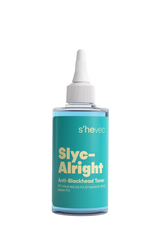
| Oily and combination | Slyc-Alright, Hi Girls Bye Pores, Matte's Up? | Slyc-Alright 2% salicylic acid, alcohol-free; Hi Girls Bye Pores 10% niacinamide; Matte's Up? SPF 50+, matte finish |
| Dry | Rice Rice Baby, Hydra Back Baby, Love In Blue This Time | Love In Blue This Time 2% ceramide complex; Hydra Back Baby two humectants |
| Sensitive | Rice Rice Baby Brightening Rice Toner, Magic Foam Party, Hydra Back Baby, Love In Blue This Time | Rice Rice Baby pH 5.5–6.5, no AHA or BHA for exfoliation; Magic Foam Party SLS-free and paraben-free |
| Normal and all types | Any Time Of Day Water-Based Moisturising Cream (all types), Magic Foam Party Foaming Face Cleanser (sensitive, combination, normal, oily) | Any Time Of Day water-based and silicone-free; 5% niacinamide and 2% 8D hyaluronic acid |
The table does not give a routine order. You can work out your morning and evening routine step by step in the routine builder by choosing your skin type and priorities. Which product to use at which step and at what time of day is covered in our articles on the oily skin routine, the dry skin routine and normal skin care. The label is information about suitability, not a promise of results; if you have noticed sensitivity, do a patch test on the inner forearm first, whatever the product.
What does an at-home skin type check not tell you?
- It is not a measurement; it does not replace device-measured values for hydration, oiliness, water loss and pH.
- It cannot identify a skin condition; signs of sensitivity can also occur with some skin conditions.
- Sunburn, a recent procedure or a newly started product can change the result on any given day.
When should you see a doctor?
- If you have persistent redness, flaking, itching or burning: this picture may not be explained by sensitive or dry skin; because an at-home check cannot identify a skin condition, your doctor needs to assess the cause of the symptoms.
- The AAD notes that dryness that persists despite following its advice may be caused by an underlying condition and recommends seeing a dermatologist.
- If a product you apply to your skin, including moisturiser, causes burning, stinging or irritation, the AAD recommends telling a dermatologist.
Frequently asked questions
Is the tissue test reliable?
It gives a rough idea. The result varies with the time of day, the season and the products you used that day, so it is read not on its own but together with how tight your skin feels and what you see in the mirror.
Does pore size indicate skin type?
Not on its own. In the device-based classification study, pores appear as a subcategory of oiliness; in other words, the look of pores is assessed together with shine.
Can your skin type change over time?
It can. Oiliness is known to change with age, diet and climate; the same skin may shine more in the T-zone in summer and feel tighter in winter. Repeat the observation when the season changes.
Does make-up affect the observation?
It does. Make-up and sunscreen change both shine and the feeling of tightness; do the observation only on cleansed, bare skin.
Sources
- Seo JI et al. An objective skin-type classification based on non-invasive biophysical parameters. J Eur Acad Dermatol Venereol. 2022.
- Sakuma TH et al. Oily skin: an overview. Skin Pharmacol Physiol. 2012.
- Misery L et al. Sensitive skin. J Eur Acad Dermatol Venereol. 2016.
- American Academy of Dermatology (AAD). Dermatologists’ top tips for relieving dry skin.
This content is for information only and does not replace medical advice. s'hevec products are cosmetic products and are not intended for medical treatment. It was prepared by the s'hevec Team on the basis of the s'hevec product data library and the sources listed above.


