
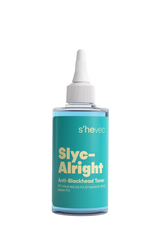


Not all the dark dots on the nose, chin and forehead are blackheads; some are sebaceous filaments, which every skin has. Telling the two apart determines which care will be useful and which will only cause unnecessary irritation.
In short: A blackhead is a plug of sebum and dead cells at the opening of a pore that stays open to the surface and looks dark; it is most noticeable on the nose, chin and forehead. Lighter-coloured dots lined up in a similar pattern on the nose, on the other hand, are often sebaceous filaments and are considered separately from blackheads. To reduce the look of blackheads, salicylic acid (BHA) is the key ingredient: Slyc-Alright contains 2% salicylic acid and 1.2% AHA, with a pH range of 3.9–4.2. Squeezing is not recommended.
What causes blackheads?
A blackhead forms when sebum and dead cells build up at the opening of a pore and create a plug that stays open to the surface; the exposed top looks dark. A review on pores names high sebum output as one of the main reasons pores become more visible and notes that the skincare routine you follow can also affect how pores look. We cover the other causes of pore size in our article why pores become more visible.
How do you tell blackheads from sebaceous filaments?
Colour and distribution are the most practical way to tell them apart: blackheads look dark and appear individually, while lighter-coloured dots lined up in a similar pattern on and around the nose are often sebaceous filaments. In the dermatology literature, sebaceous filaments are discussed as a separate topic from blackheads, so the two should not be approached with the same expectations. The table below is a general distinction based on what you can see in a mirror; it is not a diagnosis.
| Observation | Blackhead | Sebaceous filament |
|---|---|---|
| Colour | Dark, almost black | Lighter; grey, yellowish or close to skin tone |
| Location and distribution | Nose, chin, forehead; individual, irregular | Mostly the nose and the area around it; similar-looking, in rows |
| What to do | A regular BHA step helps loosen the plug | Do not squeeze them as if they were plugs; care is aimed at the overall look of pores in the nose area |
Why do blackheads appear most on the nose?
The nose is one of the areas of the face where pores are most easily noticed, which is why dark plugs at pore openings stand out most there. The second reason is perception: some of the dots on the nose that are taken for blackheads are sebaceous filaments, which makes the number seem higher than it is. The order of application for Slyc-Alright follows this distribution too: the toner is applied first to the nose, chin and forehead, then to the rest of the face.
Should you squeeze blackheads?
No; squeezing with your fingers or trying to open them with a needle or metal tool is not recommended. The pressure is applied not only to the plug but also to the surrounding tissue; the skin becomes irritated, redness can remain and the plug does not always come out completely. The same reasoning applies to sebaceous filaments and to “squeezing pores”. The controlled approach is regular care with an ingredient that loosens the plug chemically: a review on salicylic acid explains that this acid exfoliates the uppermost layer of the skin, works by loosening the connections between cells and has a property that helps dissolve pore plugs (it is comedolytic).
How can you reduce the look of blackheads?
The look of blackheads is reduced by combining two steps, used regularly and without irritating the skin: a BHA step that helps dissolve the plug and a serum that balances the look of sebum.
- Gentle cleansing: morning and evening, without scrubbing.
- BHA toner (evening): helps dissolve the plug.
- Niacinamide serum: helps balance the look of pores and sebum.
- Moisturiser: supports comfort after the acid.
- Sunscreen (morning, last step): the FDA recommends sun protection while using a product that contains BHA. Slyc-Alright and Smooth Me All Night also contain AHAs. AHAs can increase the skin's sensitivity to the sun: apply sunscreen every morning while using this product and for one week after you stop.
In the s'hevec range, three products share these steps without duplicating each other:
| Product | Its job in the routine | When | What it does not do |
|---|---|---|---|
| Slyc-Alright Salicylic Acid (BHA) Toner | Clogging: 2% salicylic acid, a low 1.2% AHA; alcohol-free, contains no niacinamide | Evening, after cleansing | Does not physically make pores smaller |
| Hi Girls Bye Pores Niacinamide Pore Serum | The look of sebum and pores: 10% niacinamide, 0.5% zinc PCA | 1–2 times a day; on toner evenings, after the toner | Does not exfoliate or stop oiliness completely |
| Smooth Me All Night Activated Charcoal Night Serum | Rough texture: 4% niacinamide; exfoliating support from AHAs and a low concentration of BHA | Evening only; on evenings without the toner | Does not change the structural size of pores; not designed for deep resurfacing |
The rule of thumb is simple: one acid product per evening. Slyc-Alright and Smooth Me All Night are not layered on the same evening, as both contain acids. Because Hi Girls Bye Pores contains no acids, it can be added on the same evening as the toner. Our collection of products for visible pores brings together other options for the look of pores and blackheads. For how often to use Slyc-Alright and how to apply it, see our guide to using a salicylic acid toner.
Does activated charcoal draw out blackheads?
What matters in blackhead care is not activated charcoal but an acid that helps dissolve the plug and niacinamide, which balances the look of sebum. In Smooth Me All Night, too, activated charcoal is the supporting ingredient that gives the formula its name; we explain what the claims are based on in our activated charcoal serum guide.
What does blackhead care not do?
- It does not change the look in a single application; any difference in the look of blackheads is seen with regular use.
- It does not require using products more often; do not go beyond the frequency of use on the label.
- It does not change the structure of the pore.
When should you see a doctor?
- Red, painful bumps that sit deep in the skin are not a plug open to the surface, so they do not count as blackheads; do not try to clear them with a toner or by squeezing. If such bumps recur often, last for days or leave marks, see a dermatologist.
- If stinging after the salicylic acid toner does not pass within minutes, or irritation carries on into the following days, stop using it and consult a doctor.
- If you are allergic to salicylates or acetylsalicylic acid (aspirin), consult your doctor before starting salicylic acid products.
- If you are pregnant or breastfeeding, or have a skin condition, consult your doctor before use.
Frequently asked questions
Do blackheads come back?
Yes. Because pores keep producing sebum, new plugs can form; so blackhead care is not a one-off job but an ongoing step in your routine.
What is the difference between blackheads and whiteheads?
Both are plugs at the opening of a pore; in a whitehead, the top of the plug is closed, while in a blackhead it is open to the surface and therefore looks dark. What a whitehead (closed comedone) is and how to reduce its look are covered in our guide to closed comedones; we have set out how to build a routine for skin where these plugs are common in a step-by-step routine for blemish-prone skin.
Do nose strips clear blackheads?
A strip is designed to stick to the surface part of the plug at the pore opening and pull it away; it does not change how blackheads form. Because the pore keeps producing sebum, the plug forms again; the regular care step is salicylic acid, which loosens the plug chemically. Do not apply a strip to irritated or sunburnt skin, and do not use it if pulling it off causes stinging or noticeable redness.
Should you use a comedone extractor?
Not at home. The problem with squeezing by hand applies to a metal tool too: the pressure is also applied to the surrounding tissue. The AAD notes that squeezing a blackhead can cause the area to become infected or leave a scar. The same question for whiteheads is covered in detail in our guide to closed comedones.
How do you care for blackheads on sensitive skin?
The FDA recommends testing a product containing BHA on a small area before applying it to a large one. On sensitive skin, start the BHA step at a lower frequency; you can also apply it only to areas where blackheads are concentrated, such as the nose, chin and forehead.
Should oily skin with blackheads use a moisturiser?
Yes; in a routine with an acid step, a moisturiser supports comfort and helps prevent the skin from drying out further. On oily skin, a light texture is enough; in the s'hevec range, Any Time Of Day is water-based and silicone-free.
For blackheads, should you start with Slyc-Alright or Smooth Me All Night?
If clogging is the priority, start with Slyc-Alright; its key active is salicylic acid. If rough texture and the look of pores are both priorities, Smooth Me All Night is a good fit; its key actives are 4% niacinamide and AHAs, with salicylic acid at a supporting level. The second product is added on separate evenings once your skin has adjusted to the first.
Sources
- Singh Y et al. Sebaceous Filaments. Dermatol Pract Concept. 2021.
- Lee SJ et al. Facial Pores: Definition, Causes, and Treatment Options. Dermatol Surg. 2016.
- Arif T. Salicylic acid as a peeling agent: a comprehensive review. Clin Cosmet Investig Dermatol. 2015.
- U.S. Food and Drug Administration (FDA). Beta Hydroxy Acids.
- American Academy of Dermatology (AAD). Acne: Signs and symptoms.
This content is for information only and does not replace medical advice. s'hevec products are cosmetic products and are not intended for medical treatment. It was prepared by the s'hevec Team on the basis of the s'hevec product data library and the sources listed above.


