


AHAs and BHA are both exfoliating acids, but they do not do the same job in the same place. Which one you choose depends less on your skin type than on the main concern you see: dullness and roughness on the surface, or congestion in the pores?
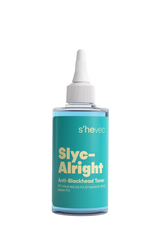
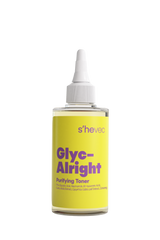
In short: AHAs (glycolic and lactic acid) help shed dead cells from the skin's surface and are chosen for dullness, rough texture and uneven tone. BHA (salicylic acid) helps loosen pore congestion and is the better fit for the look of blackheads. They also differ in sun sensitivity: glycolic acid can increase it, while in a comparative study salicylic acid showed no significant increase. As separate products, they are used on different evenings. At s'hevec, Glyc-Alright contains 7% glycolic acid (pH 3.5–4.0) and Slyc-Alright 2% salicylic acid (pH 3.9–4.2).
What is the difference between AHA and BHA?
The basic difference is where they work: AHAs work mainly on the skin's surface, while BHA also works on the surface but comes into its own with congestion at the pore opening. According to the FDA, the degree of exfoliation with AHAs depends on the type and concentration of the acid, the pH of the product and the other ingredients in the formula. Salicylic acid, on the other hand, is described in the literature as comedolytic, meaning an ingredient that helps loosen pore congestion; by loosening the bonds between cells (a desmolytic effect), it makes it easier for dead cells to come away. For more on each ingredient, see our articles what is glycolic acid and what is salicylic acid.
| Feature | AHA | BHA |
|---|---|---|
| On the label | Glycolic Acid, Lactic Acid | Salicylic Acid |
| Where it works | Skin surface | Surface and pore opening |
| Focus | Rough texture, dullness, uneven tone, the look of fine lines | The look of blackheads and clogged pores |
| Sun sensitivity | Can increase it; sun protection is needed | No significant increase in a comparative study; sun protection is still needed |
What are the types of AHA?
AHAs are acids that carry a hydroxyl group in the alpha position. According to a review, the ones most often used in cosmetics are glycolic, lactic, malic, tartaric and citric acid; mandelic acid also belongs to this family. According to the FDA, in some formulas an AHA is present not for exfoliation but only to adjust the pH, so seeing an AHA on the label does not mean the product is an exfoliant.
| AHA | Note | At s'hevec |
|---|---|---|
| Glycolic acid | The smallest molecule in the AHA family | Key active in Glyc-Alright; paired with lactic acid in Red Of Love; part of the low-concentration AHA complex in Slyc-Alright |
| Lactic acid | A larger molecule than glycolic acid | Red Of Love |
| Mandelic acid | Classed as an AHA | Not in the range |
| Malic and tartaric acid | Counted in the AHA family | Not included as a key active |
| Citric acid | Usually referred to as an AHA; according to the FDA, occasionally also listed as a BHA | Not included as a key active |
Which acid for which skin?
The choice is driven first by the look you want to address, then by how well your skin tolerates acids. A decision table based on s'hevec formula data:
| Concern and skin | Acid | s'hevec option |
|---|---|---|
| Dullness, rough texture, uneven tone; combination, normal, oily skin | AHA | Glyc-Alright: 7% glycolic acid + 2% niacinamide, pH 3.5–4.0, evening |
| The look of blackheads and clogged pores; combination, normal, oily skin | BHA | Slyc-Alright: 2% salicylic acid + 1.2% AHA, pH 3.9–4.2, no alcohol, evening |
| Both surface and pore targets; beginner and intermediate | AHA + BHA in one formula | Red Of Love: rinsed off after 5–10 minutes, no more than 2 times a week; Slyc-Alright also contains 1.2% AHA alongside 2% salicylic acid (its key active is BHA) |
| Sensitive or dry skin, skin not ready for acids | A toner with no exfoliating acids | Rice Rice Baby: pH 5.5–6.5, contains no exfoliating acids; the skin types recommended on its label include sensitive and dry skin |
Glyc-Alright Glycolic Acid Toner and Slyc-Alright Salicylic Acid (BHA) Toner are applied with a cotton pad in the evening after cleansing; with both, start on a few evenings a week and increase the frequency as your skin tolerates it. Slyc-Alright balances salicylic acid with a low-concentration AHA complex; its key active is salicylic acid. Rice Rice Baby Brightening Rice Toner contains no AHAs or BHA for exfoliation; acid toners are not the first choice for dry and very sensitive skin. All the toners, night serums and peels that contain AHAs or BHA are brought together in our collection of products containing AHAs and BHA.
Can you use AHA and BHA on the same evening?
As separate products, they are not layered on the same evening: if you use both Glyc-Alright and Slyc-Alright, keep them to different evenings.
Where the two acids do come together is in a single, balanced formula. Red Of Love AHA/BHA Peel Serum combines AHAs (glycolic and lactic) with BHA in one formula; its pH is in the 3.6–3.9 range, it is rinsed off thoroughly with water after 5–10 minutes and it is used no more than 2 times a week. As it already contains both acids, do not add an acid toner on the day you use Red Of Love. The steps are in our article how to use an AHA BHA peel.
Which is less irritating, AHA or BHA?
The acid group alone does not decide this; concentration, pH, the rest of the formula and how often you use the product decide it together. The FDA reports that there are claims that BHAs serve similar goals for the skin's appearance without the irritation sometimes seen with AHAs, but it does not present this as verified information. The FDA's observation on AHAs is more useful as a guide: the more serious reactions have been seen most often with peel-type products that exfoliate the most. If you are new to acids, look at the product type and frequency before the type of acid: a toner rather than a peel, and a few evenings a week rather than every evening.
Do AHA and BHA make skin sensitive to the sun?
AHAs can; in comparative data, the same effect was not seen with BHA. In a study comparing the two acids with short-term application, glycolic acid increased the skin's sensitivity to simulated sunlight, while salicylic acid made no significant change in the markers measured.
This result does not make sun protection unnecessary with BHA; with both acids, daytime sunscreen is part of the routine. The FDA recommends sun protection while using AHAs and for one week after you stop; the warning is covered in detail in the glycolic acid guide linked above.
Do AHA and BHA have side effects, and who should take care?
They can; as both are exfoliants, both can cause irritation. Reports sent to the FDA about products containing AHAs include burning, swelling, itching, peeling and increased sunburn. If stinging after an acid toner does not pass within a few minutes, or redness lasts until the next morning, take a break from that product.
- First use: try the toner or peel on a small area before applying it to your whole face; start with a few evenings a week.
- Irritated skin: do not apply acids to broken or irritated skin.
- Salicylate sensitivity: if you are allergic to salicylates or acetylsalicylic acid (aspirin), consult your doctor before using a product containing BHA.
- Children: products containing BHA are not used on children.
- Pregnancy, breastfeeding or an ongoing skin condition: If you are pregnant or breastfeeding, or have a skin condition, consult your doctor before use. This includes acid toners and peels.
Frequently asked questions
AHA or BHA for blackheads?
BHA. Salicylic acid's ability to help loosen pore congestion (it is comedolytic) is what makes it stand out for the look of blackheads; at s'hevec, the matching product is Slyc-Alright. An acid toner helps reduce the look of blackheads; it does not mechanically push out a lodged plug.
Which is better for sensitive skin?
On very sensitive skin, the first step may not be an exfoliating acid. Rice Rice Baby is a toner with a pH of 5.5–6.5 that contains no AHAs or BHA for exfoliation; the skin types recommended on its label include sensitive skin. Begin by trying it on a small area. If you would like to try an acid, start with a single product and use it infrequently.
Is salicylic acid really a BHA?
According to the FDA, from a chemist's point of view salicylic acid is not a true beta hydroxy acid; the cosmetics world refers to it as a BHA and the name has stuck. Salicylic acid is also the BHA most often used in cosmetics.
Is lactic acid an AHA or a BHA?
Lactic acid is an AHA, like glycolic acid. The AHA part of Red Of Love is made up of these two acids.
What is mandelic acid, and how does it differ from glycolic acid?
Mandelic acid is also an AHA, while glycolic acid is the smallest molecule in this family. We do not have a source that shows in a comparative study that mandelic acid is gentler than glycolic acid, so we make no such claim. The s'hevec range has no product containing mandelic acid; for surface care with an AHA, the options are Glyc-Alright and Red Of Love.
Sources
- U.S. Food and Drug Administration (FDA). Alpha Hydroxy Acids.
- U.S. Food and Drug Administration (FDA). Beta Hydroxy Acids.
- Kornhauser A et al. The effects of topically applied glycolic acid and salicylic acid on ultraviolet radiation-induced erythema, DNA damage and sunburn cell formation in human skin. J Dermatol Sci. 2009.
- Arif T. Salicylic acid as a peeling agent: a comprehensive review. Clin Cosmet Investig Dermatol. 2015.
- Tang SC et al. Dual Effects of Alpha-Hydroxy Acids on the Skin. Molecules. 2018.
- Jacobs SW, Culbertson EJ. Effects of Topical Mandelic Acid Treatment on Facial Skin Viscoelasticity. Facial Plast Surg. 2018.
This content is for information only and does not replace medical advice. s'hevec products are cosmetic products and are not intended for medical treatment. It was prepared by the s'hevec Team on the basis of the s'hevec product data library and the sources listed above.


